
What Is an Inverted Winger? The inverted winger is not just a position it is a complete tactical philosophy. It is the 2014 Champions League final. Arjen Robben receives the ball on the left side of the penalty area his weaker side, technically speaking. He has done this exact movement eleven thousand times in training. He opens his body slightly, looks up, and with his right foot curls the ball into the bottom corner past Iker Casillas.
Real Madrid wins the trophy. Germany won the World Cup a month later with a similar player — same position, same philosophy. Robben runs off celebrating, and somewhere in a coaching office in Munich, Pep Guardiola is nodding because he already knew. He had known for years.
That goal did not happen by accident. It happened because of a role — a position — that had quietly been rewiring how attacking football works for over a decade. A role that looked simple on the surface but was actually a complete reinvention of how wide players operate.
The inverted winger. The most influential attacking position in football over the last twenty years. And if you are not fully across what it means, how it works, and why every top manager on the planet obsesses over it, then you are genuinely missing a huge piece of the game you love.
First, the Traditional Winger — and Why Managers Started Getting Bored with It
Before the inverted winger became the dominant attacking concept it is today, football had a very clear idea of what a winger was supposed to do.
Stay wide. Beat the full-back for pace. Get to the byline. Cross the ball into the box. Simple. Effective for decades.
The old-school winger was essentially a delivery man. His entire job was to get into wide positions, stretch the play, and whip crosses into the penalty area for strikers and arriving midfielders. Players like Ryan Giggs in his younger years, Marc Overmars at Arsenal, or David Beckham — though Beckham was more of a wide midfielder than a traditional winger — all operated from wide positions with delivering the ball as their primary function.
And it worked. For a long time, it worked brilliantly.
But football has always been an evolutionary game. Defences got smarter. Full-backs became more athletically capable of tracking traditional wingers to the byline and forcing them wide into less dangerous positions. The crossing game became increasingly predictable. Teams started packing the penalty area specifically to deal with the inevitable ball played across from deep wide positions.
Coaches started asking a different question. What if the winger did not stay wide? What if instead of delivering from the flank, he cut inside and became a direct goal threat from a more central position?
The answer to that question changed football permanently.

What Is an Inverted Winger? The Complete Tactical Answer
To truly understand what an inverted winger is, you have to forget everything the traditional game taught you about wide players. Here is the clearest way to explain it.
A traditional right winger is right-footed and plays on the right side. Logical, comfortable, predictable. He runs down the line, gets to the byline, and crosses with his right foot.
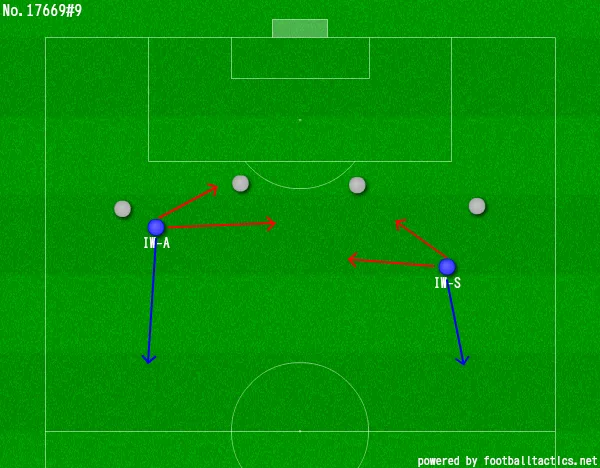
An inverted winger is the opposite. He is right-footed but plays on the left side, or left-footed playing on the right side. When he receives the ball on the left, his instinct is not to go down the line because his weaker foot is nearest to the touchline. Instead, he cuts inside onto his stronger right foot. He moves from the wide left position diagonally toward the centre of the pitch — toward the goal.
That diagonal cut inside is the defining movement of the role. Everything else — the shooting threat, the passing options, the defensive disruption it creates — flows from that single, devastating movement.
It sounds almost too simple. A player on the wrong side of the pitch who drifts inside. Why is that so hard to defend?
Because it creates an impossible problem for two defenders simultaneously.
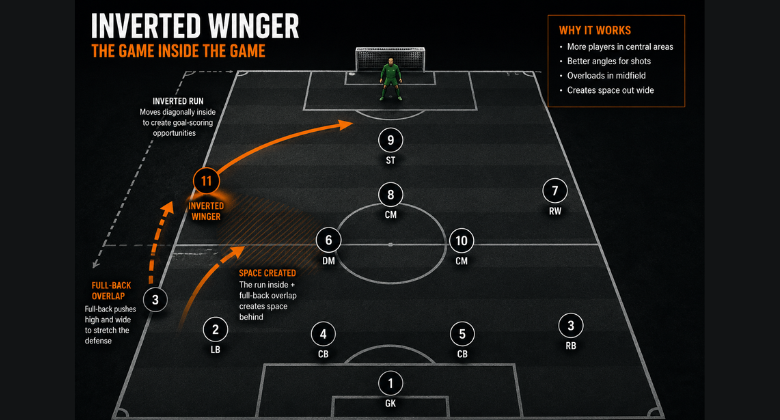
When the inverted winger cuts inside, the full-back has to decide — do I follow him inside and leave space behind me on the flank? Or do I hold my position and let him advance toward the goal unopposed? Either answer is wrong. Follow him inside, and the overlapping full-back from the attacking team arrives into acres of space on the flank. Hold position, and the inverted winger has a clear path to the penalty area, his strong foot ready to shoot.
The centre-back faces the same dilemma from the other direction. Step out to engage the inverted winger, and you leave your central defensive partner exposed. Hold the line, and the inverted winger arrives at the edge of the box essentially unchallenged.
It is not magic. It is geometry. And it is devastatingly effective.
The Tactical Genius Behind the Role
Every elite manager who has deployed an inverted winger successfully has done so with one principle in mind. What makes the inverted winger genuinely brilliant is not just the cut inside. It is everything that movement triggers across the entire attacking structure.
When a right-footed player on the left wing starts drifting inside, the left-back from the same team pushes forward into the vacated space on the flank. The inverted winger has essentially created a free man by removing himself from a position. That overlapping left-back now has width, space, and time — and the opposition defence has to react to two threats simultaneously.
Meanwhile, in the centre, the striker and the interior midfielders are making their own runs off the ball, exploiting the confusion the inverted winger’s movement has caused. The defensive structure is being pulled in three directions at the same time from one simple positional action.
This is why Guardiola and Klopp built entire tactical systems around this principle. Not because the inverted winger is individually brilliant — although many of them are — but because structurally, the role unlocks attacking possibilities for every other player around it.
How It Works in a 4-3-3
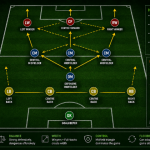
In Guardiola’s 4-3-3 — arguably the formation most associated with the inverted winger in modern football — the system is specifically designed to maximise the role. The left winger is right-footed, the right winger is left-footed. Both cut inside simultaneously in attacking phases. The full-backs push high and wide, occupying the space vacated by the wingers. The two interior midfielders make late diagonal runs into the half-spaces.
At peak performance, this creates a genuine five-versus-four or five-versus-five situation across the final third, with the defensive structure of the opposition constantly being stretched across multiple directions. Opponents know it is coming. They still cannot stop it. That is how well-designed the system is.
In a 4-2-3-1
In the 4-2-3-1, the inverted winger operates slightly differently. The two-man pivot behind them provides defensive security, allowing the inverted wingers more freedom to commit to their runs inside. The number ten between them creates an additional central passing option, meaning the inverted winger has multiple ways to play after cutting inside — shoot, play the ten, find the striker, or lay off to the arriving midfielder. Multiple solutions from one movement.
In a 3-4-3
With three centre-backs, the wing-backs provide natural width without needing the winger to do it. This actually gives the inverted winger in a 3-4-3 the most freedom of all — he can commit fully to the inside run knowing the wing-back is covering the flank behind him. Some of the most effective inverted winger displays in recent football have come in 3-4-3 systems precisely because the structural support is already in place.

The Players Who Defined the Role — and How They Each Did It Differently
This is where the conversation gets genuinely interesting, because every great inverted winger has been slightly different. Same position, same general movement, but entirely individual in execution.
Arjen Robben
Robben was the prototype for the modern era. Right foot, left wing, diagonal run, shot. He did not have an enormous repertoire of moves. He had essentially one primary move — the cut inside onto his right foot — and he executed it with such technical precision and timing that even when defenders knew exactly what was coming, they still could not stop it.
His balance was extraordinary. His ability to ride challenges while shifting the ball onto his right foot meant that even physical contact did not stop the run. His finishing from the edge of the box was clinical. Robben was not the most complete footballer of his generation, but in this specific movement, he was practically unplayable for almost fifteen years.
Mohamed Salah
Salah took the Robben blueprint and added an extra dimension — explosive pace. Where Robben worked on technique and timing, Salah added the ability to beat defenders with sheer speed before cutting inside. When Salah is at his best — the 2017-18 season at Liverpool was probably the purest exhibition of inverted winger football ever seen in the Premier League — he combines the positional intelligence of a tactical analyst with the physical tools of an elite sprinter.
His goal against Arsenal in December 2017 — receiving on the left, cutting past three defenders, finishing across the goalkeeper — was not just a great goal. It was a perfect demonstration of every element the inverted winger role requires, executed at an absolute maximum level in real match conditions.
At Liverpool, Salah’s role was also deeply intertwined with Robertson’s overlapping runs from left-back. That partnership — inverted winger cutting inside, full-back arriving in the space — was the engine of one of the most feared attacking units in European football for several years.
Lionel Messi
Messi is a complicated inclusion in this conversation because he transcended any specific positional label. But during his peak Barcelona years, he was operating fundamentally as an inverted winger — right-footed on the right side in the early years, then later dropping deeper as a false nine. His half-space movement, his diagonal runs, his tendency to cut inside rather than go to the byline — all textbook inverted winger instincts executed by arguably the greatest player the game has ever seen.
The difference with Messi was that his dribbling ability meant he could get through defenders that Robben or Salah would play around. But the positional principle — strong foot toward goal, diagonal run inside, unpredictable in the final third — was fundamentally the same.
Kylian Mbappe
Mbappe adds a dimension no previous inverted winger had in quite the same way — frightening straight-line pace combined with the intelligence to cut inside at the right moment. He has played on the left at PSG and for France extensively, though his natural right-footed preference means the left side is where the inverted winger role applies most cleanly.
His role at Real Madrid has required tactical adaptation — he is not a traditional inverted winger there in the strictest sense — but his fundamental threat still comes from diagonal movements inside from wide positions. The pace is so extreme that defenders cannot afford to give him any momentum or he is simply gone.
Vinicius Jr.
Vinicius is the most athletically spectacular version of the role currently active. He starts from an extremely wide position, beats the full-back with pace and technical trickery, and arrives in the half-space at full speed after having already beaten his immediate marker. By the time he is cutting inside, he has built momentum that makes him almost impossible to recover against. His improvement in the final decision — when to shoot, when to play the pass, when to draw the foul — has transformed him from an exciting but inconsistent winger into a genuine Champions League match-winner.
What Great Inverted Wingers Do That Most People Never Notice
The goals get all the attention. The cuts inside, the curling shots, the assists — those are what end up on the highlights. But the genuinely elite inverted wingers do three things that rarely make the highlights package and are absolutely fundamental to the role working properly.
They create space without the ball. The positioning of an inverted winger before he receives the ball is at least as important as what he does after. By standing slightly inside before the ball arrives, he draws the full-back inward, opening the wide channel for the overlapping full-back. This happens before a single touch is taken. The creation of space through positioning is invisible to most viewers and completely apparent to every coach on the touchline.
They press intelligently from the front. Modern inverted wingers are not just attacking players. When the team is out of possession, they have to press from wide positions with a specific structure. A well-directed press from the inverted winger funnels the opponent’s full-back toward the touchline, setting up a pressing trap. Badly executed pressing from this position leaves the team exposed behind.
They combine constantly with the striker and the interior midfielder. The cut inside is the headline. The quick combination — give-and-go with the striker, layoff to the arriving midfielder, one-two with the full-back — is what makes it sustainable. An inverted winger who only cuts and shoots is predictable within fifteen minutes. One who combines constantly and cuts selectively is genuinely difficult to plan for over ninety.
The Weaknesses — Because No Role Is Perfect
The inverted winger creates problems defensively for the team when not executed properly.
When the inverted winger cuts inside and loses the ball, the team is immediately exposed on the flank. The overlapping full-back is forward. The inverted winger is now out of position centrally. There is a large open space on the flank behind both of them. A quick transition from the opposition — one accurate long pass — and they are in a two-on-one situation in that space before the defensive structure can recover.
This is why pressing teams love playing against poorly disciplined inverted wingers. Force the turnover in the wrong moment, and the counter-attack opportunity is enormous.
It is also why Guardiola is obsessive about what his inverted wingers do defensively — where they press, at what angle, when they hold and when they engage. The attacking brilliance of the role requires defensive discipline as the foundation. Without that structure, the role creates as many problems for the team as it solves.

What You Need to Actually Play This Role
If you are a young player, a coach, or just someone who finds themselves wondering what it actually takes, these are the genuine attributes that separate a great inverted winger from an average one.
Strong-foot finishing from outside the box is non-negotiable. The entire movement points toward a shot or a pass from the area just outside the penalty area. If the technical quality of the delivery from that position is not there, the role loses its primary threat.
Dribbling and close control under pressure matter enormously because the cut inside happens in a congested area. The transition from wide to central involves defenders closing from multiple angles.
Football intelligence — knowing when to cut and when to go outside, when to shoot and when to pass, when to press and when to hold — separates elite inverted wingers from one-trick players. Robben, at his very best, understood that occasionally going to the byline made the cut inside more effective. He created doubt. That doubt was the weapon.
Positional awareness off the ball is arguably the most underrated attribute. Being in the right starting position before the ball arrives determines how much space and time the player has when it does. This is not exciting. It does not appear in highlight reels. It is everything.
And finally — and this one is often overlooked — defensive work rate. The best inverted wingers in the world press properly, track back when required, and understand their defensive responsibilities within the system. Without it, no top manager will trust them in a big game.
Why This Role Will Define the Next Decade of Football
Defensive evolution is constant. Teams are getting better at dealing with the inverted winger — more compact defensive structures, full-backs who are tactically trained to manage the inside-outside dilemma, midfielders who track the late runners more aggressively.
But the attacking evolution is keeping pace. Players like Yamal, Vinicius, and the next generation coming through in Spain, France, and South America are arriving with half-space intelligence and inverted winger instincts already built in at seventeen and eighteen years old. They are faster, technically more complete, and tactically more educated than any previous generation of wide attackers.
The role is not going anywhere. If anything, the tactical arms race between attacking teams trying to exploit the inside cut and defending teams trying to close it off will produce the most interesting tactical football of the next decade. The half-space battles, the pressing structure off the back of the inverted winger’s position, the overlapping full-back partnerships — all of it flows directly from this one positional concept.

A Final Thought That Probably Says It All
There is a story — possibly apocryphal, but believable enough to be worth telling — that when Guardiola first started working with Robben at Bayern Munich, he told him something along the lines of: “Your job is not to beat the full-back. Your job is to make the full-back not know where to stand.”
Whether it is true or not does not really matter. The philosophy is completely accurate. The inverted winger’s greatest weapon is not pace, not technique, not finishing ability — it is uncertainty. The uncertainty every defender feels when a right-footed player drifts toward them on the left side, ball at feet, body open, the entire pitch in front of him.
Do I engage? Do I hold? Do I follow? Do I wait?
In that fraction of hesitation — that tiny moment of tactical indecision — the inverted winger has already won.
Frequently Asked Questions
What is an inverted winger in simple terms? An inverted winger is a wide player who plays on the opposite side to their stronger foot — a right-footed player on the left, or a left-footed player on the right. Instead of going toward the touchline, they cut inside onto their stronger foot, creating shooting and passing opportunities from central areas.
What is the difference between a traditional winger and an inverted winger? A traditional winger stays wide, hugs the touchline, and delivers crosses. An inverted winger moves inside, threatens the goal directly with their stronger foot, and creates space for overlapping full-backs behind them. The tactical impact and attacking threat of both roles are entirely different.
Who is the best inverted winger of all time? Arjen Robben defined the role for a generation and is probably the purest example. But Lionel Messi, operating from wide right in his Barcelona peak, produced more consistently devastating performances in the role. Current contenders include Salah, Vinicius Jr., and Lamine Yamal.
Which formations best suit an inverted winger? The 4-3-3 is the most natural home for inverted wingers — it provides full-back support, interior midfielder arrivals, and a clear central striker. The 4-2-3-1 and 3-4-3 also work very effectively, depending on how the team is set up defensively.
Can an inverted winger play as a traditional winger? Yes, and the best ones occasionally do — deliberately — to create doubt in the defender’s mind. Robben occasionally went to the byline specifically to make the defender uncertain about which way he would go next time. The threat of going outside makes the cut inside more effective. Pure one-trick inverted wingers are far easier to defend than those who occasionally vary the movement.
What are the defensive responsibilities of an inverted winger? Inverted wingers are expected to press the opposition full-back from specific angles when out of possession, track back to support the full-back defensively in transition, and maintain positional discipline to prevent opposition counter-attacks through the wide channel they have vacated when cutting inside.
More tactical breakdowns and football analysis every week at Sports Express — intelligent football writing for fans who want to understand the game more deeply.
For Newsletter or Email us: hello@sportsexpress.site