
HOW TO PLAY FALSE 9 POSITION: Complete Tactical Guide: Modern Football • Tactical Intelligence • Player Development. Every time you drop deep to receive, the opposition has to answer an ugly question—follow you and leave gaps behind, or hold their line and let you turn between the lines—and whichever they choose, your next pass, dribble, or quick one-two can rip their shape apart
What If Your Striker Stopped Being a Striker?
Imagine this: your striker drops 20 metres deep into midfield, your two wingers suddenly have acres of space to sprint into, and your opponents’ centre-backs have no idea whether to follow him or hold their line. That split-second hesitation? That is the magic of the False 9.
Modern football has relentlessly redefined every position on the pitch, but no role has been reinvented quite as dramatically as the number 9. For decades, the centre-forward was simple: big, powerful, occupying defenders and finishing chances in the box. Then came a generation of managers — most notably Pep Guardiola — and a generation of players — most iconically Lionel Messi — who asked a radical question: what if the striker’s greatest contribution was not being where defenders expected him?
The result was the False 9: one of the most tactically sophisticated, intellectually demanding, and devastatingly effective roles in world football. This complete guide will teach you exactly how to play the position, what skills you need, which formations suit it best, and how to train like a modern False 9.
False 9 (noun): A centre-forward who drops into midfield to receive the ball and create play, rather than staying high to act as a target man. Primary keyword: how to play false 9 position.
What Is a False 9? (Beginner-Friendly Explanation)
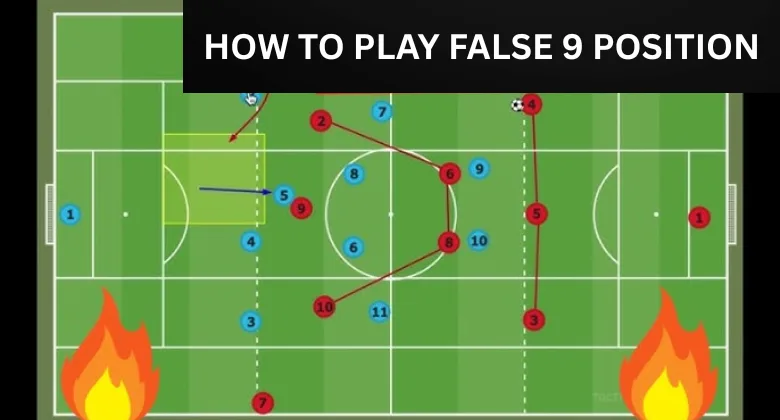
Definition: A False 9 is a centre-forward who occupies the No. 9 shirt but behaves like a No. 10 or an advanced midfielder. Instead of staying near the opponent’s goal to hold up play or stretch the defence, the False 9 drops deep — often to the halfway line — to receive the ball, link play, and orchestrate attacks.
Why Is It Called ‘False’?
The word “false” refers to the deception at the heart of the role. On the team sheet, a number 9 is listed, suggesting a traditional striker will lead the line. The opponent’s centre-backs prepare for a physical duel or a player making runs in behind. Instead, the striker drops out of their zone entirely, leaving the centre-backs stranded — follow him, and you open the space he just vacated; stay, and you give him time on the ball deep in midfield. It is a positional lie that creates a tactical truth.
The Simple Analogy
Think of the False 9 as a midfielder wearing a striker’s number. They carry the goals-and-assists expectation of a forward but the movement, vision, and passing intelligence of a playmaker. They are the Swiss Army knife of modern attacking football.
False 9 vs Traditional Striker
Understanding the False 9 is much easier when you compare it directly to the striker archetypes it replaced. Below is a detailed breakdown of the three main centre-forward roles and how they differ.
| Attribute | False 9 | Target Man | Poacher |
|---|---|---|---|
| Primary Position | Drops to midfield | High & central | Edge of the box |
| Physical Profile | Agile, technical | Big, strong, aerial | Compact, sharp |
| Main Job | Create & link play | Hold up & flick on | Finish chances |
| Runs | Arrives late, fluid | Short lay-offs | Darting in behind |
| Pressing | Leads press from front | Shields ball | Lurks, minimal press |
| Famous Examples | Messi, Firmino, Totti | Ibrahimovic, Lukaku | Van Nistelrooy, Inzaghi |
| Best Formation | 4-3-3, 4-6-0 | 4-4-2, 4-5-1 | 4-3-3 with crosses |

Core Responsibilities of a False 9
The False 9 role is multi-layered. Unlike a poacher who has one primary task — scoring — the False 9 must fulfil four interconnected tactical functions every time the team has possession.
Dropping Deep Into Midfield
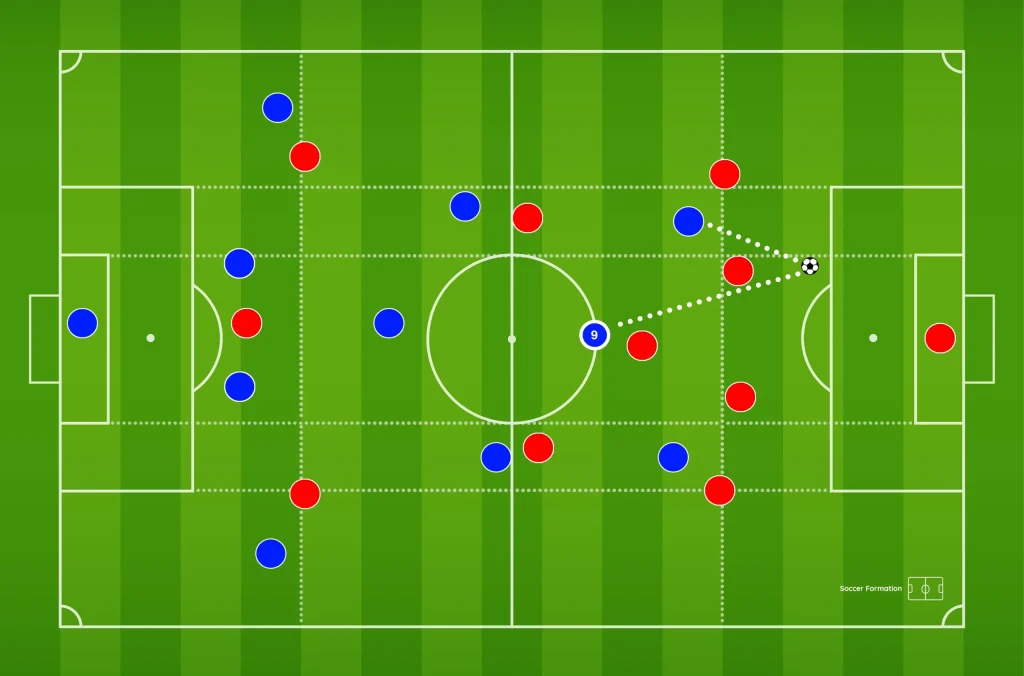
The most visually distinctive aspect of the role. When the goalkeeper or centre-backs receive the ball, the False 9 makes a sharp, purposeful run toward the halfway line to offer a passing option. This movement creates two simultaneous problems for the opposition:
- Numerical overload in midfield — the False 9 becomes an extra body in central areas where the opponent may only have two or three players.
- Positional chaos for centre-backs — do they follow the striker and abandon their defensive structure, or stay and allow him to control the game from a dangerous central position?
Linking Play Like a Playmaker
Once the False 9 receives the ball in midfield, they must execute with the composure and quality of a Number 10. This means:
- Playing quick one-touch or two-touch passes to maintain tempo.
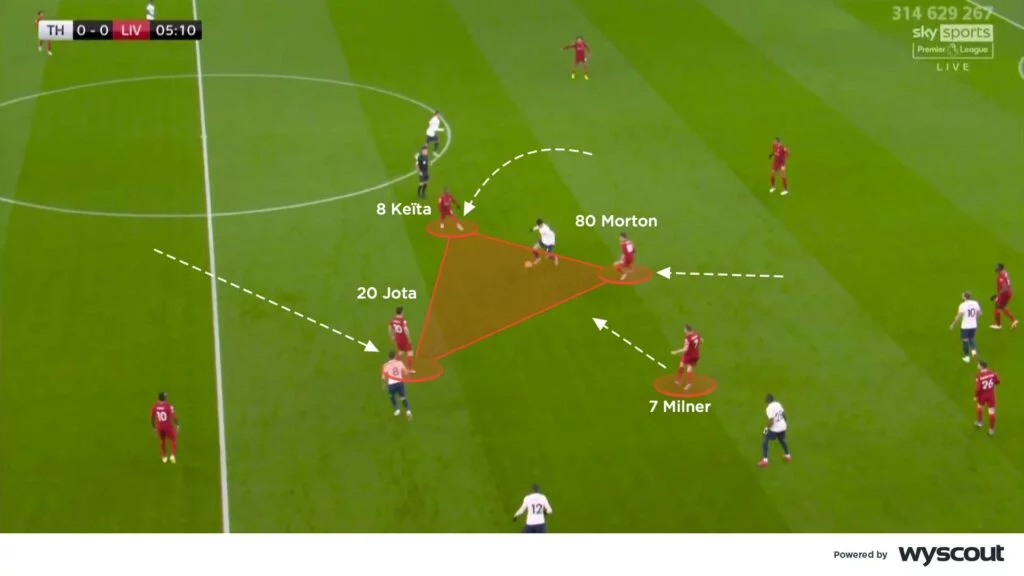
- Forming passing triangles with midfielders — three players constantly forming the shape of a triangle to ensure the ball-carrier always has at least two safe outlets.
- Switching play to wider areas when central pressure arrives.
- Making intelligent combinations — wall passes, overlaps, third-man runs — to break defensive lines.
Creating Space for Teammates
Perhaps the most underrated responsibility: the False 9 makes space they will never use. When a centre-back abandons their position to follow the dropping striker, they leave a gap. The job of the False 9 is to engineer that gap so the wingers — or a late-arriving midfielder — can exploit it.
This is sometimes called a “spatial sacrifice”: the False 9 gives up their traditional goal-scoring position to unlock space for teammates who can then arrive at pace, unmarked, into the box.
Late Runs Into the Box
The final — and most decisive — phase. After drawing the centre-back out of position and releasing the ball to a winger, the False 9 must immediately reverse their movement and sprint into the penalty area. Timing is everything:
- Too early: defenders have time to recover and track the run.
- Too late: the chance is gone, the cross or cutback wasted.
- Perfect timing: the False 9 arrives at the far post or penalty spot a half-second before any defender — unmarked, in space, ready to finish.
Key Skills You Need to Play False 9
The False 9 demands a broader skill set than virtually any other position in football. Here is what you must develop to excel in the role:
Vision & Football IQ
Before you receive the ball, you must already know where it is going next. The False 9 reads the game three or four moves ahead — identifying where space will open, which teammate is making a run, and which defender is out of position. Football IQ is the single most important attribute in this role.
Ball Control Under Pressure
Dropping into midfield means receiving the ball with opponents immediately pressing from behind. The False 9 must have exceptional first touch — the ability to control the ball with one contact and instantly protect it with their body, creating time to survey options.
Quick Decision-Making
The False 9 rarely has more than two seconds on the ball before pressure arrives. Every touch must have a purpose: pass, turn, dribble, or switch play. Hesitation kills the attack. Decision-making must be automatic.
Spatial Awareness
Knowing where you are, where your teammates are, and — critically — where the defenders are at any given second. Constant 360-degree scanning before receiving the ball is non-negotiable for attacking positioning at this level.
Finishing Ability
Despite spending much of the match away from the box, the False 9 must be a clinical finisher. When the late run into the area comes off, and the ball arrives, there is no second chance. Goals and assists remain the ultimate measure of every centre-forward.
False 9 skills · football intelligence · attacking positioning · false 9 movement · number 9 role modern football
Best Formations for a False 9 Role
Not every system suits a False 9. The role needs specific structural conditions to function — most importantly, width on both flanks and numerical security in central midfield.
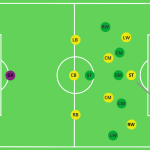
4-3-3 — The Classic False 9 System
The most effective and widely used formation for a False 9. Three central midfielders provide numerical superiority in the middle of the park, meaning when the False 9 drops in, the team can still control possession.
Two wide forwards take advantage of the space vacated by the striker, making diagonal runs in behind the defender who follows the False 9. This was precisely the system Pep Guardiola used at Barcelona (2008–2012), with Lionel Messi operating as a False 9 in front of Xavi, Iniesta, and Busquets — widely regarded as the most tactically complete club side in football history.
4-6-0 — The Revolutionary System
The most extreme manifestation of the False 9: no recognised striker at all. Six players occupy midfield and attacking-midfield positions, all with freedom to rotate. The False 9 in this system is whoever is highest in possession at any given moment. Requires extraordinary tactical intelligence from all ten outfield players and absolute buy-in from the squad.
Fluid Attacking Systems
Many modern managers — from Klopp’s Liverpool to Arteta’s Arsenal — use hybrid structures that do not fit a numbered formation neatly. In these systems, the False 9 role emerges through in-game positional rotation rather than fixed tactical assignment. The striker is trusted to read the game and drop when the moment demands it.

How to Train Like a False 9
The False 9 is made in training. Unlike a target man whose physical attributes largely define their ceiling, the False 9 can massively improve through deliberate, intelligent practice. Here are the four core training pillars.
Movement Drills
The drop-and-turn sequence is foundational. Set up cones 25 metres apart. Make a run toward the defender’s position (backward movement from the front line), receive a pass, control in one touch, turn, and play forward to a third player.
- Repeat 20 times, alternating which shoulder you turn over.
- Add a passive defender behind you to simulate pressure.
- Progress to an active defender applying light pressure.
Passing & Vision Drills
One-touch passing in tight rondos sharpens decision speed. But the most important training habit is scanning before you receive:
- Before every pass arrives, turn your head left and right (check your shoulders).
- Practise receiving the ball with your back to goal and immediately knowing — without looking — where the open man is.
- Scanning exercises: partner calls a colour/number, the split-second they pass; you must respond while controlling the ball.
Positioning Awareness
The hardest skill to train: knowing when to drop and when to stay forward. The rule of thumb is simple:
- Drop deep when your team needs a passing option, and the midfield is congested.
- Stay forward when a winger is 1v1 — your run could serve as a distraction.
- Drop deep when the ball is at centre-back or goalkeeper level.
- Attack the box when the ball is wide, and a cross or cutback is coming.
Small-Sided Games
5v5 or 6v6 on a small pitch is arguably the best training tool for a False 9. The restricted space forces quick decision-making, frequent touches, and constant positional scanning. All the cognitive demands of the role are compressed into a high-intensity, enjoyable session that also develops creativity and off-the-ball movement.

Common Mistakes to Avoid
Even technically gifted players regularly make these errors when learning the False 9 role. Awareness is the first step to correction.
Dropping Too Deep, Too Often
The False 9 who spends every minute of the game in their own half stops being a threat. If you never arrive in the box, defenders stop tracking your runs — the whole tactical mechanism breaks down. The drop must be purposeful, not habitual.
Over-Dribbling
The False 9 receives the ball in congested central areas. There is rarely space to dribble past two or three players. When you receive deep, your first thought must be passing — use your dribble to create a passing angle, not to escape pressure alone.
Poor Timing of Runs
Running too early into the box gives defenders time to track and recover. Running too late means the moment has passed. Watch the winger’s body shape and first touch: if they are setting to cross or cut back, that is your trigger to move.
Lack of Chemistry With Teammates
The False 9 role only works when the entire team understands and believes in it. Wingers must know to attack space when the striker drops. Midfielders must be ready to receive quick combinations. Build chemistry through repetitive training — the same patterns again and again until they are automatic.
Advantages and Disadvantages of the False 9 Role
✅ Advantages
- Unpredictable attack: defenders struggle to mark a player who is never where they expect.
- Midfield dominance: the dropping striker creates numerical overloads that enable greater possession control.
- Tactical flexibility: the same player can be a creator one moment and a finisher the next.
- Space creation: vacating the centre-forward area generates opportunities for late-arriving runners.
❌ Disadvantages
- No physical presence in the box: set pieces and long balls lose their threat without a target man.
- Requires intelligent players throughout the squad: if wingers do not make the right runs, the system collapses.
- Can struggle vs deep defences: when opponents park the bus with 10 men behind the ball, there is less space to exploit.
- High physical and cognitive demands: the False 9 covers more ground than a traditional striker, pressing from the front and still arriving in the box.

Famous False 9 Players
The greatest False 9s in football history share one thing: extraordinary football intelligence. Here are four case studies that illuminate the role from different eras and styles.
Lionel Messi — FC Barcelona (2008–2012)
The defining False 9 of the modern era. Under Pep Guardiola, Messi was moved from the right wing into a central False 9 role. His ability to receive between the lines, beat defenders in tight spaces, and still deliver double-digit Champions League goals made him effectively unmarkable. Guardiola called the positional shift the most important tactical decision of his managerial career.
Roberto Firmino — Liverpool FC (2015–2023)
Firmino is the perfect example of a False 9 measured by influence rather than statistics. Under Jurgen Klopp, Firmino rarely led the scoring charts — but his pressing triggers, link-up play with Salah and Mane, and ability to drag centre-backs out of position were the invisible architecture behind one of the most feared attacks in Premier League history.
Francesco Totti — AS Roma (2006–2017)
As Totti’s pace diminished with age, Roma coach Luciano Spalletti reinvented him as a False 9 at 29 years old. Totti’s technical genius — his vision, first touch, and passing range — made him arguably more dangerous in this deeper role than he had been as a pure forward.
Cesc Fabregas — Spain / FC Barcelona (2006–2012)
Fabregas is the purest midfield player-turned False-9. Spain’s 2012 European Championship triumph was built around a 4-6-0 system with Fabregas as the highest player — a false striker with no striker’s instincts but the passing intelligence of the world’s best playmaker. Spain won the tournament without a traditional centre-forward, scoring a single goal.
Tactical Example: How False 9 Works in a Real Game
Abstract tactics become clear when you see them play out in real time. Here is a step-by-step breakdown of a classic False 9 attacking sequence — inspired by Messi’s movements at Barcelona.
The Sequence
- The ball starts with the goalkeeper. Opponent’s 4-4-2 presses high, their two strikers closing down the centre-backs.
- The False 9 (Messi) drops sharply to the halfway line. Their right centre-back faces the dilemma: follow him or hold?
- The right centre-back follows. A 20-metre corridor of space opens behind him, between the centre-backs.
- The ball is played to Messi in midfield. He receives, turns in one touch, and immediately plays a through-ball into the channel.
- The right winger (Iniesta or Pedro) sprints onto the through-ball, now 1v1 with the left-back.
- Messi immediately accelerates forward toward the penalty spot. The right centre-back who followed him is now 30 metres out of position.
- The winger cuts back. Messi arrives unmarked. Goal.
The False 9 created the goal with three actions: the drop (creating space), the pass (releasing the winger), and the run (exploiting the gap they engineered). The finish was just the final act of a sequence they began 15 seconds earlier.

Frequently Asked Questions
These are the most common questions about the False 9 role — optimised for featured snippet answers.
What does a False 9 do in football?
A False 9 is a centre-forward who drops deep into midfield to link play and create space, rather than staying near the opponent’s goal. They combine the goal threat of a striker with the playmaking ability of a midfielder, making them tactically unpredictable and difficult to mark.
Is a False 9 better than a traditional striker?
Neither is universally better — they solve different problems. A False 9 is ideal when a team wants midfield control and has quick wingers to attack space. A traditional striker is better against deep defences or when crosses and long balls are the primary means of attack. The best teams have both options available.
Can beginners play False 9?
Yes, but it requires patience and specific training. Beginners should start by mastering the drop-and-turn movement, one-touch passing in small spaces, and the habit of scanning before receiving. The positional intelligence that defines elite False 9 play develops over months and years of deliberate practice.
Which formation is best for a False 9?
The 4-3-3 is the most reliable formation for a False 9. Three central midfielders provide stability when the striker drops, and two wide forwards are perfectly positioned to exploit the space left by a centre-back who follows the False 9. The 4-6-0 is the most extreme version of the system but demands exceptional squad intelligence.
Who is the greatest False 9 of all time?
Lionel Messi, in his 2008–2012 period at Barcelona under Pep Guardiola, is the consensus answer. His combination of technical brilliance, football IQ, and goal contribution in the role has never been replicated. However, Francesco Totti and Roberto Firmino represent important variations of the same archetype.
What is the difference between a False 9 and a No. 10?
Both roles involve dropping deep and creating play, but a No. 10 traditionally operates behind a striker — they are not expected to be the furthest player forward. The False 9 wears the striker’s number and is nominally the highest attacker, which is precisely what creates the positional confusion that makes the role so dangerous.
Conclusion: Intelligence Over Strength
Football has always rewarded the clever over the merely powerful, but no role makes that argument more forcefully than the False 9. This is a position for thinkers — players who understand that the most valuable thing a striker can do is sometimes not be where strikers are supposed to be.
The False 9 drops deep not to hide from the game, but to change it. They confuse defenders not through trickery but through logic — exploiting the structural rules that defenders follow and using those rules against them. They sacrifice the glory of arriving at the goal first so that a teammate can arrive there unmarked.
If you want to play False 9, start with your movement. Learn to drop and turn. Build your passing accuracy under pressure. Train your scanning so that every time the ball arrives at your feet, you already know exactly where it is going next. Watch matches tactically — not for the goals, but for the space that was created three passes before the goal.
The greatest False 9s in history — Messi, Firmino, Totti, Fabregas — were not necessarily the fastest or the strongest players on the pitch. They were the smartest. In the modern game, that intelligence is worth more than any physical attribute.
The False 9 is proof that in football — as in life — the biggest impact often comes from doing the unexpected thing in the unexpected place at exactly the right moment.
For Newsletter or Email us: hello@sportsexpress.site