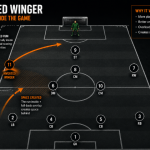

What Is a Half-Space in Football? In modern football, creating space is crucial for attacking teams to be successful. One way to do this is to exploit the half-spaces on the pitch. Half spaces are the areas between the penalty box and the D on either side of the pitch, as shown below. These areas are often referred to as the “inside channels” and are considered to be strategic locations for creating and exploiting space.
Most people think football matches are won by the best striker or the most creative playmaker. They are wrong.
The real battles in modern football happen in zones most fans never even look at. Not the penalty box. Not the wide flanks. Somewhere in between — a narrow, invisible corridor that the world’s best coaches obsess over every single day.
It is called the half-space. And if you do not understand it, you are missing the single most important tactical concept in football right now.
What Is a Half-Space in Football?
A half-space in football is the vertical, inside lane located between the central corridor and the wide flanks. It is a crucial tactical zone, often termed the “inside channel” or Halbraum (German), used to unlock defences because it provides better shooting/passing angles and less congestion than the centre. Players use it to play diagonal passes, create overloads, or trigger movements for overlapping full-backs
The half-spaces are the two vertical lanes between the wide areas and the central lane. Sometimes, these five lanes are numbered: the wide areas are numbered 1 and 5, the centre is numbered 3, and the half-spaces are numbered 2 and 4. Teams tend to aim to get on the ball in the half-spaces in the final third, usually around the edge of the penalty area, where they can threaten the goal.
What Exactly Is the Half-Space?
Let us keep this simple. Divide the football pitch into five equal vertical lanes from left touchline to right touchline. You get:
- Far left lane — the left wing
- Inside left lane — the left half-space
- Centre lane — the central channel
- Inside right lane — the right half-space
- Far right lane — the right wing
The two inside lanes — sitting between the wing and the centre — those are the half-spaces.
They are not wide enough to be a winger’s territory. They are not central enough to be the striker’s zone. They live in the gap between the two defenders’ responsibilities. And that gap is where modern football is genuinely won and lost.
Here is a practical way to picture it. Stand at the centre circle and look toward the goal. Imagine two goalpost-wide lines extending from each post straight up the pitch. Everything outside those lines but inside the touchline? That is your half-space. A player positioned there has a diagonal view of goal, space to run, and two confused defenders who both think it is the other one’s job to deal with him.

Why Is the Half-Space So Dangerous?
Three reasons. All connected. All-powerful.
First, it creates defensive confusion.
When an attacker enters the half-space, the defensive structure faces an immediate dilemma. The full-back thinks the centre-back should track him. The centre-back thinks it is the full-back’s responsibility. That split-second hesitation — that is all a quality attacker needs. By the time the defenders agree on who is marking him, he has already played the killer pass or pulled the trigger.
Second, the shooting angle is genuinely difficult to defend.
A shot from the half-space arrives at a diagonal. The goalkeeper cannot fully commit to the near post or the far post. He is essentially guessing. Compare that to a central shot where everything is in front of him, or a wide-angle shot where the target is tiny. The half-space offers maximum goal to aim at with minimum goalkeeper comfort. It is not a coincidence that the most deadly finishers of the modern era — Salah, Mbappe, Robben — all naturally gravitate toward this zone.
Third, it breaks defensive lines more effectively than any other position.
A pass into the half-space splits the defensive block diagonally. It forces two lines — the defensive line and the midfield line — to react simultaneously. When both lines react at the same time, gaps open everywhere else. That is positional play football at its most ruthless.
Where does the term ‘half-space’ originate?
The term ‘half-space’ is thought to have first been talked about as a specific area of the pitch in Germany, and comes from the translation of the German word ‘halbraum’. The half-spaces are also, in English, sometimes referred to as the inside channels.
Mastering Half-Spaces: How City, Liverpool, and Barca Dominate
Manchester City reigns supreme in world football, and their half-space wizardry is a cornerstone of that dominance. Pep Guardiola, the tactical genius at the helm, has redefined these zones between centre and flanks. Stars like Kevin De Bruyne and Bernardo Silva thrive here, slicing through defences with clever runs that unlock City’s attack.
Their secret weapon? Lightning-quick one-touch passes. An attacker grabs the ball in the half-space, flicks it instantly to a teammate, and boom—space opens up for rapid progression. It demands elite technique and razor-sharp awareness, but it shreds opponents when it clicks.
Liverpool, under Jürgen Klopp, weaponises half-spaces with ferocious high-pressing flair—especially in their 2020/21 and 2022 seasons. The iconic front three of Mohamed Salah, Roberto Firmino, and Sadio Mané were half-space hunters, dragging defenders apart to ignite attacks.
They stretch the pitch wide, hugging the touchlines to pull defences thin horizontally. This chaos leaves gaps for midfield runners to exploit, turning Liverpool’s press into pure goal-scoring gold.
Barcelona’s tiki-taka legacy pulses through their half-space mastery. Icons Xavi and Andrés Iniesta owned these areas, ghosting into pockets for quick interplay that dismantled foes.
Triangles are their hallmark: midfielders link up in tight half-space formations, offering endless passing lanes. Constant movement creates angles, zips the ball forward, and overwhelms defences.
Nail half-spaces like these teams, and you unlock endless chances while choking the opponent’s creativity. It takes top-tier skill and vision, but get it right. It’s a total game-flipper.

How Elite Teams Use the Half-Space Tactically
This is where it gets really interesting.
Guardiola’s 4-3-3 and the Half-Space Takeover
Pep Guardiola does not ask his wingers to stay wide. He asks them to vacate the wide lane deliberately and move inside into the half-space. The full-back then pushes high into the space the winger just left, creating a numerical overload on the outside while the winger operates dangerously from the inside.
The result? The opposition defence is constantly being stretched in opposite directions simultaneously. Step out wide, and the half-space is open. Stay narrow, and the full-back is completely free on the overlap.
Manchester City have run this pattern hundreds of times. It is not luck. It is a deliberately engineered system designed around half-space occupation.
Barcelona’s 3-2-5 Build-Up Structure
When Barcelona are in possession and building from the back, they frequently shift into what analysts call a 3-2-5 shape. Three defenders, two pivots, and five attacking players across the front. Those five are not spread evenly. Two of them — the inverted wingers — are positioned directly in the half-spaces.
This forces the opposition to defend five attacking threats across the final third simultaneously. A back four simply does not have the numbers or the positional clarity to deal with that. Something always gives. And it almost always gives in the half-space.
The Interior Midfielder Run — Most Overlooked Movement in Football
In a standard 4-3-3, the two interior midfielders — not the pivot, the two flanking midfielders — have a specific job that most casual fans completely miss. Their role is to make late diagonal runs into the half-space as the ball arrives in wide areas.
When the winger receives wide, every defender focuses on the wide threat. The interior midfielder is already moving diagonally into the half-space behind the defensive line. By the time anyone picks up the run, he is arriving at the edge of the box unmarked.
Kevin De Bruyne has turned this movement into a career-defining art form. He does not beat defenders with pace or tricks. He simply arrives in the right zone at the right moment, consistently, and the goals and assists follow naturally.
Real Match Examples That Show the Half-Space in Action
Manchester City vs Real Madrid — Champions League 2023
City’s 4-0 aggregate demolition of Real Madrid was built almost entirely on half-space exploitation. Bernardo Silva and De Bruyne constantly operated in both inside channels, drawing Real’s midfield out of shape. The central gaps that opened up allowed City to play through the press repeatedly and arrive in goal-scoring positions with pace. Real had no answer because their defensive structure was designed for wide threats, not coordinated half-space occupation.

Spain at Euro 2024
Spain’s tournament-winning campaign was the purest half-space masterclass at the international level in recent memory. Lamine Yamal on the right and Nico Williams on the left were not traditional wingers hugging the touchline. They constantly drifted inside, operated in the half-spaces, and forced every opposition defence to make impossible choices. Their combined goal contributions across the tournament came overwhelmingly from or through those inside channels.
Liverpool Under Klopp — The Full-Back Revolution
Trent Alexander-Arnold and Andrew Robertson redefined what full-backs do because of the half-space. Their winger moves inside, the full-back pushes forward into the vacated half-space, and suddenly you have a technically brilliant passer delivering from the most dangerous crossing position on the pitch. Liverpool’s attacking system was not complicated. It was geometrically brilliant.
Players Who Genuinely Master This Zone
Kevin De Bruyne — The definitive half-space midfielder of his generation. Positional intelligence over raw pace, every time.
Lamine Yamal — At 17, his natural half-space instinct is already world-class. Drifts, waits, and moves at exactly the right moment.
Vinicius Jr. — He does not start in the half-space. He creates it himself by beating the full-back and arriving there at full speed.
Jude Bellingham — His Real Madrid performances are built on late half-space arrivals from a second-wave run. Defenders simply cannot track him because he starts deeper than they expect.
Pedri — Perhaps the most naturally intelligent half-space player in world football right now. His movement is subtle, almost invisible, until suddenly he is in the perfect position and the defence has no recovery time.

Why the Half-Space Will Define the 2026 World Cup
Here is an opinion stated directly: the 2026 World Cup will be decided by which national teams understand and execute half-space football most effectively.
The players competing in 2026 have spent their entire careers at clubs where this concept is fundamental. Spain, France, England, Germany, Brazil — every serious contender has attacking players who are instinctively comfortable in those inside channels.
The nations that defend the half-space with organised, compact lines will survive in the knockout rounds. The nations that leave those inside corridors unguarded will be picked apart in ninety minutes, regardless of their individual talent.
International football is catching up to club football tactically. And the concept that is catching up around, more than any other, is the half-space.
Final Thought
The half-space is not complicated. It is just the space between the wing and the centre of the pitch. But what happens in that space — the confusion it creates, the goals it produces, the defensive structures it dismantles — is the closest thing modern football has to a guaranteed formula for winning.
Guardiola knows it. Arteta knows it. Xabi Alonso knows it. Now you do too.
Next time you watch football, stop following the ball constantly. Watch the spaces on either side of the centre. Watch where the best players move before the ball arrives. You will see the half-space being attacked, defended, won, and lost — in every single match, at every single level.
And you will never watch football the same way again.
Frequently Asked Questions
What is the half-space in football? The half-space is the vertical lane between the wide wing area and the central channel. There are two on every pitch, and they are the most dangerous attacking zones in modern football.
Which teams use the half-space best? Manchester City, Barcelona, the Spain national team, and Arsenal currently use half-space principles most consistently and effectively at the elite level.
Why is the half-space hard to defend? Because it sits between two defenders’ responsibilities — the full-back and centre-back — creating confusion about who should engage. Whatever choice defenders make opens a gap somewhere else.
Who are the best half-space players in football right now? Kevin De Bruyne, Lamine Yamal, Jude Bellingham, Vinicius Jr., and Pedri are the clearest examples at the top level currently.
Will the half-space matter at the World Cup 2026? Absolutely. It will be the central tactical battleground of the tournament. Teams that master it will dominate. Teams that ignore it will struggle to create consistent chances regardless of individual quality.
For Newsletter or Email us: hello@sportsexpress.site