
4-3-3 Formation Explained: Some formations come and go. They have their moment, their era, their manager who makes them famous, and then football moves on. The 4-3-3 is not one of those formations.
It has been here since the 1950s. It survived the counter-attacking revolution of the 1980s, the two-striker obsession of the 1990s, the rise of the 4-2-3-1 in the 2000s, and the three-at-the-back revival of the 2010s. Every decade, someone declares it outdated. Every decade, the best team in the world is playing it.
Barcelona’s tiki-taka. Klopp’s Liverpool. Ajax under Van Gaal. Brazil in its pomp. Celtic under Stein. Real Madrid’s galactico era. All of them, fundamentally, built on the same structural skeleton — four defenders, three midfielders, three forwards.
What makes a formation that old still feel revolutionary every time a great coach picks it up? That is the question worth answering. And the answer, when you dig into the tactical architecture of the 4-3-3, is both simpler and more complex than most people realise.
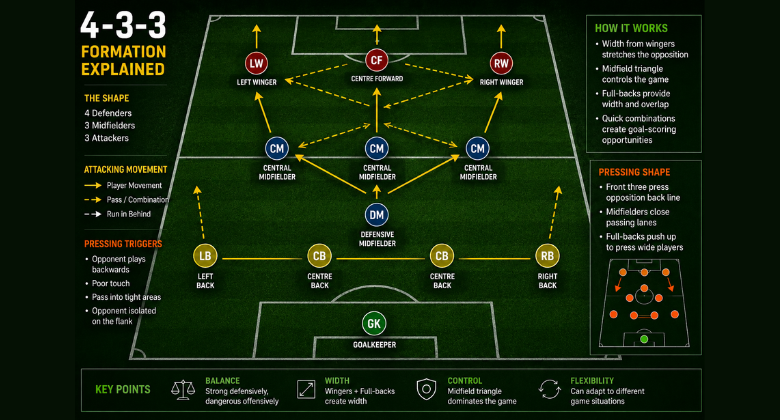
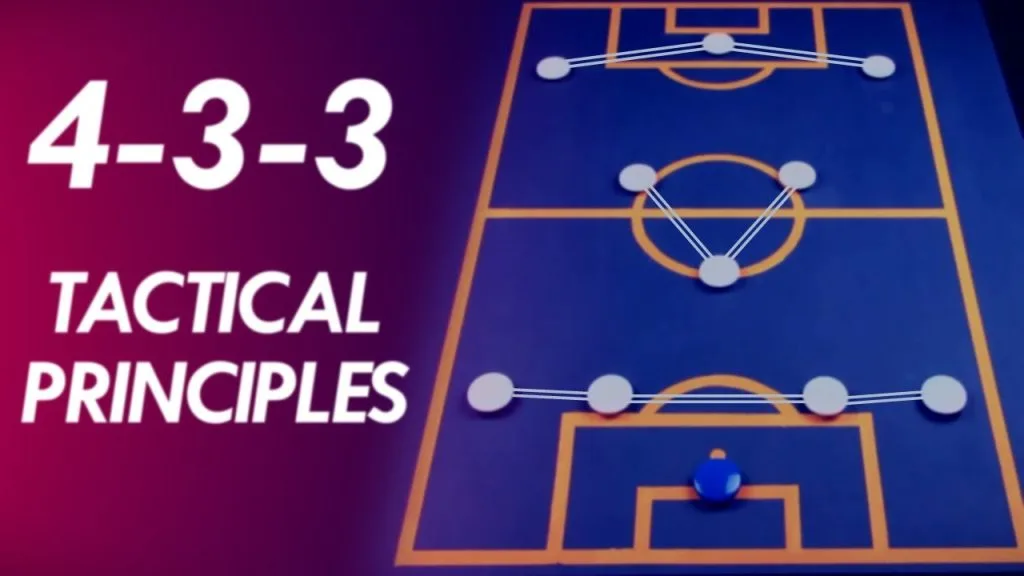
The 4-3-3 formation, explained simply, is this: four defenders, three midfielders, three forwards. But that simple description hides one of the most complex and rewarding tactical systems football has ever produced.
4-3-3 Formation Explained: What the Numbers Actually Mean
To have the 4-3-3 formation explained properly, you need to understand not just where the players stand — but why they stand there and what happens when the ball moves.
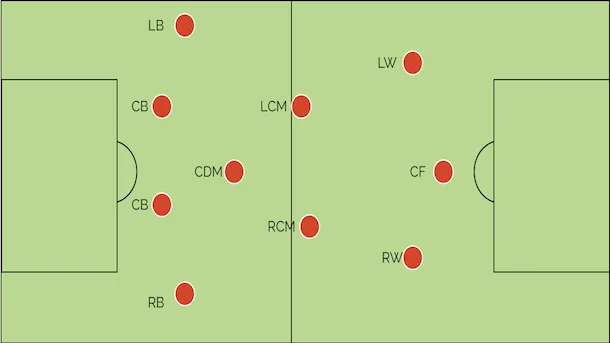
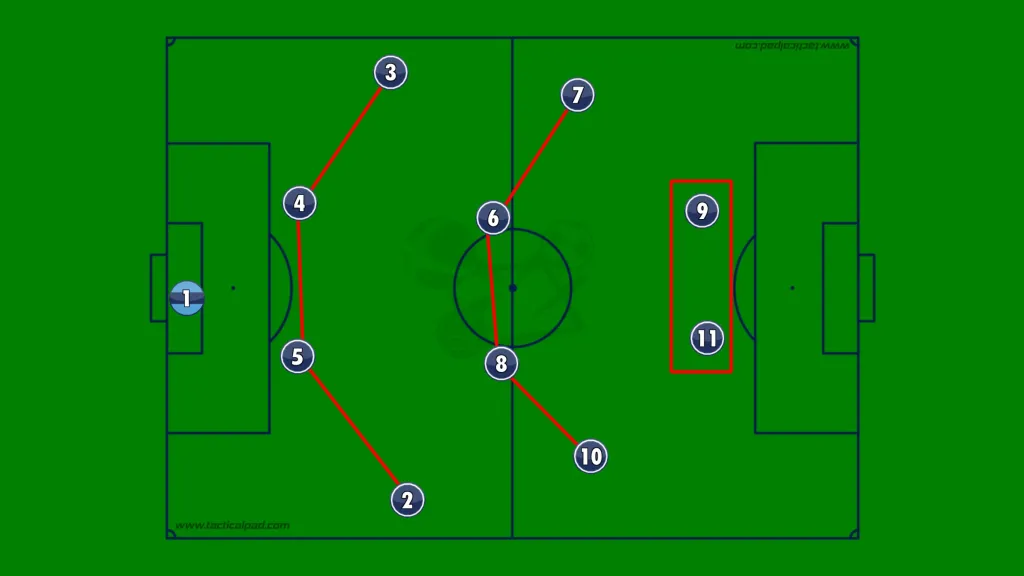
Strip it back to basics. Four defenders across the back — two centre-backs flanked by two full-backs. Three midfielders in the centre of the pitch, typically with one deeper defensive midfielder and two more attack-minded players on either side of him. Three attackers across the front — a central striker and two wide forwards.
That is the skeleton. But like any skeleton, what matters is not the bones — it is everything built on top of them.
The 4-3-3 is a framework, not a fixed shape. In possession, it morphs. Out of possession, it contracts. In transition, it stretches and reshapes within seconds. The same four-three-three you see on a tactics board at kick-off looks nothing like the shape you see when a team is pressing high in the opposition’s half or holding a one-goal lead in the 85th minute.
That flexibility is precisely why it has survived six decades of tactical evolution while other formations have been discarded. It is not rigid enough to be broken by a single tactical adjustment. It breathes.
The History Behind the 4-3-3 Formation Explained
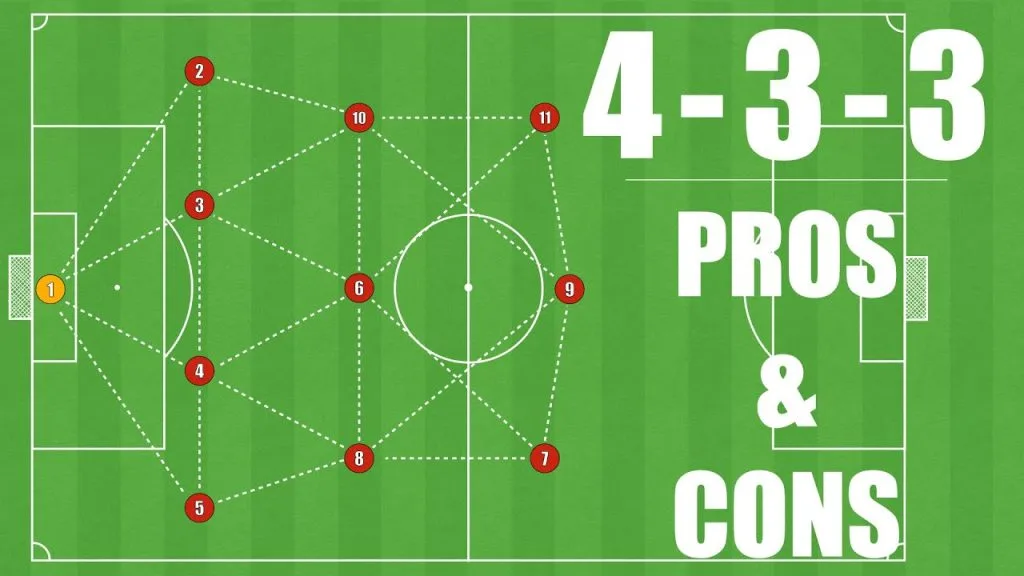
Most modern football fans associate the 4-3-3 with Pep Guardiola or Jürgen Klopp. Understandable. But the formation’s roots go much deeper than that. The midfield triangle is the most discussed element whenever coaches have the 4-3-3 formation explained to their players in pre-season.
The first widespread use of something recognisably resembling the 4-3-3 came from Brazil in the late 1950s and early 1960s. The 1958 and 1962 World Cup-winning Brazilian sides played with a shape that placed enormous emphasis on wide forwards and a supporting midfield triangle. Garrincha and Zagallo operated in wide attacking positions in 1958 — not tracking back, not crossing from the byline consistently, but cutting inside and linking play in ways that European defences simply had no tactical answer for.
In Europe, the most significant early 4-3-3 adoption came from Ajax and the Netherlands in the late 1960s and early 1970s. Rinus Michels built the foundational Ajax team around a pressing 4-3-3 with Johan Cruyff at its centre. The concept of Total Football — players interchanging positions fluidly while maintaining the structural shape — was built on top of the 4-3-3 framework. Ajax won three consecutive European Cups. It took the Netherlands to the 1974 World Cup final. It was genuinely revolutionary football that the rest of the world spent the next twenty years trying to understand and replicate.
Celtic under Jock Stein had already used similar principles in 1967, when the Lisbon Lions became the first British side to win the European Cup playing an attacking 4-3-3 that overwhelmed Internazionale’s defensive catenaccio system. If you want a single match that proved the 4-3-3 could beat anything defensively sound with attacking intensity, Lisbon 1967 is it.
The formation went through various iterations across the following decades — sometimes sitting deeper as a 4-5-1 when teams without the ball were conservative, sometimes used as a high-pressing unit, sometimes structured as a pure possession system. But it never disappeared. Every generation of great coaching minds has eventually returned to it.
How the 4-3-3 Works — The Tactical Engine
Understanding how the 4-3-3 functions requires looking at it in three distinct phases: in possession, out of possession, and in transition. The formation looks and behaves differently in each phase, and the quality of a team using it is often determined by how seamlessly they move between those phases.
In Possession
When a team with the ball is building from the back in a 4-3-3, the shape typically shifts. The defensive midfielder drops between or beside the centre-backs to create a back three. This allows both full-backs to push higher and wider, providing width across the defensive line. The two interior midfielders push higher to support the attack. The three forwards stay high and central, pressing the space between the opposition’s defensive and midfield lines.
The result, in possession, looks much more like a 3-2-5 or a 3-4-3 depending on how aggressively the full-backs push. This is deliberate. It creates maximum width and maximum central presence simultaneously, forcing the opposition defence to cover the entire width of the pitch.
The passing triangles created by this shape are what make possession-based 4-3-3 teams so difficult to press. Every player has at least two passing options at any given moment — one safe, one progressive. The team can circulate the ball quickly, draw the opposition out of shape, and then find the pocket of space that opens up behind.
Out of Possession
When defending, the 4-3-3 typically contracts into a much more compact shape. The three forwards become the first line of pressure. The midfield three form a tight horizontal line behind them. The four defenders hold their shape and maintain a high defensive line if the team is pressing, or drop deeper if sitting in a mid-block.
The key to effective defensive organisation in a 4-3-3 is compactness — keeping the vertical distances between the defensive line, midfield line, and forward line short enough that the opposition cannot play between them. When those distances are right, the team can press in coordinated waves. When they are wrong — when the lines are stretched, and the spaces between them are too large — the 4-3-3 becomes extremely vulnerable to quick, direct passing.
In Transition
The most exciting moments in 4-3-3 football often happen in transition — specifically, the transition from defence to attack after winning the ball high up the pitch. When a pressing team wins possession in the opposition’s half, the three forwards are already positioned in advanced areas. The distance between the turnover and a goal attempt is minimal. The counter-press that precedes the turnover creates the space. The forward positioning of the 4-3-3 converts it into a chance.
This is the heart of Klopp’s entire tactical philosophy. Win the ball high. Play fast. Arrive in dangerous positions before the opposition can reorganise. The 4-3-3 structure makes this transition faster than almost any other formation because the starting positions of the attackers are already optimal.
Every Position Explained — Role by Role
The Goalkeeper
In a 4-3-3, the goalkeeper does considerably more than just keep goal. With a high defensive line — standard in most modern 4-3-3 setups — the goalkeeper acts as a sweeper-keeper, patrolling the space behind the defensive line to deal with balls played in behind. Ederson at Manchester City and Alisson at Liverpool are the definitive examples. Their ability to act as an eleventh outfield player, starting attacks from the back with accurate distribution, is not a luxury in this system — it is a structural requirement.
A goalkeeper who cannot play with his feet fundamentally limits what a 4-3-3 team can do in their build-up phase. The keeper is the first player in the pressing structure when the opposition presses high, and his ability to find the free man under pressure determines whether the team can play out effectively or gets pinned back.
The Centre-Backs
The centre-backs in a 4-3-3 need to be comfortable with the ball. They will spend significant time in possession, particularly during the build-up phase when the defensive midfielder drops alongside them to create a back three. Ball-playing ability, passing range, and the confidence to carry the ball forward when space opens up are all important.
Defensively, they must be comfortable with a high line — defending against balls played in behind, making well-timed offensive-line calls, and maintaining concentration across long periods when the team dominates possession and the defensive work comes in short, intense bursts.
Virgin Alisson at Liverpool was built behind a centre-back pairing in Virgil van Dijk and Joe Gomez — or Van Dijk and Joel Matip — who were both comfortable in possession and dominant aerially. That combination of technical quality and physical authority made Liverpool’s defensive foundation one of the most solid in Europe during their 2019-20 Premier League title season.
The Full-Backs
In the modern 4-3-3, the full-backs are often the most tactically complex role on the pitch. They are asked to defend, provide width in attack, overlap to support wingers, and, in some systems, tuck inside to create overloads in central areas.
Trent Alexander-Arnold at Liverpool is the extreme version of what a 4-3-3 full-back can become. His ability to deliver from wide and half-space positions, combined with his passing range from deep, made him the most creative full-back in European football for several seasons. Robertson, on the left, provided relentless energy, constant overlap runs, and defensive discipline when the team was out of possession.
The full-backs in a 4-3-3 are not just defenders who occasionally join the attack. They are genuinely central to how the team creates. They provide width when the wingers invert, create overloads on the outside when the wingers stay wide, and deliver the passes and crosses that account for a significant percentage of the team’s goal-scoring opportunities.
The Defensive Midfielder
The pivot — the deepest midfielder in a 4-3-3 — is the player who makes everything else possible. He is the base of the midfield triangle. He screens the defence, recycles possession, dictates the tempo of the game, and provides the positional security that allows the two interior midfielders to push forward aggressively.
Sergio Busquets at Barcelona was perhaps the most technically perfect pivot the game has seen in this specific role. His positional intelligence was extraordinary. He was seldom in the wrong place at the wrong time. He rarely needed to make desperate tackles because he was almost always exactly where he needed to be one step before the ball arrived. That anticipatory positioning allowed Barcelona to play the high defensive line that their possession system required.
Rodri at Manchester City has carried a similar responsibility — providing the base from which City’s entire attacking structure is built. His ball retention, his positional discipline, and his ability to shift the play quickly from one side to the other are fundamental to how Guardiola’s system functions.
The Interior Midfielders
The two midfielders flanking the pivot are required to do almost everything. They defend and attack. They press high and recover quickly. They arrive late into the penalty area from deep runs, and they drop back to form a compact midfield block when out of possession.
These are arguably the most physically and technically demanding positions in the formation. A good interior midfielder in a 4-3-3 needs pressing intensity, passing quality, box-to-box stamina, and the tactical intelligence to know when to push forward and when to hold. Getting those decisions wrong — pushing too high when the team does not have the ball, or holding too deep when a run would create a goal — is the difference between the system functioning and collapsing.
Frank Lampard and Steven Gerrard both played versions of this role at different clubs. Kevin De Bruyne has defined it during Guardiola’s era at City. Gavi and Pedri at Barcelona represent the next generation — technically brilliant, positionally intelligent, relentlessly pressing, and creative enough to unpick defences with quick combinations in tight spaces.
The Wingers
Already discussed in great detail in the inverted winger context — but within the 4-3-3 specifically, the wingers have a dual responsibility that is easy to describe and brutally difficult to execute consistently.
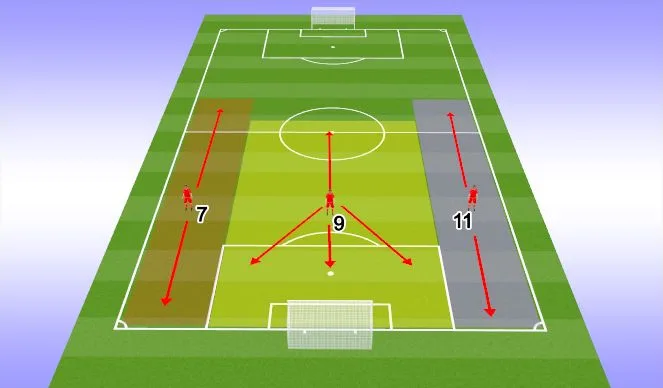
When in possession, they stretch the play, threaten inside, create overloads on the outside, or cut inside onto their stronger foot and threaten the goal directly. When out of possession, they press from high positions, forcing the opposition’s full-backs and centre-backs into difficult situations early in the defensive structure.
The best 4-3-3 wingers are capable of both functions at a high level. One-dimensional attacking wingers who refuse to press create a structural vulnerability in the formation — the opposition simply builds through the side of the pitch where the winger is not working defensively. Coaches like Guardiola and Klopp are extremely demanding about defensive work rate from wide players precisely because the formation requires it.
The Striker
The centre-forward in a 4-3-3 can be many different things depending on the variation of the system. In a high-pressure version, he leads the press, applying initial pressure on the goalkeeper or centre-backs to force mistakes and set the defensive structure in motion behind him. His starting position and pressing angle determine how effectively the whole pressing system functions.
In a possession-based 4-3-3, the striker is often the focal point of attacks — the player who stretches the defensive line, holds up the ball for arriving runners, and converts the chances that the midfield and wide players create.
Robert Lewandowski at Barcelona and Bayern Munich, Erling Haaland at Manchester City, and Firmino in the earlier Liverpool system all illustrate different versions of what the role can be. Firmino’s pressing engine and linking play were fundamental to Klopp’s Liverpool. Lewandowski’s pure finishing quality was what Bayern’s more structured 4-3-3 required. Haaland’s physical dominance and movement in behind defines City’s more direct variation of the system.
The Four Types of 4-3-3 — Different Systems, Same Formation
Possession-Based 4-3-3
Klopp’s version of the 4-3-3 formation explained in training sessions, reportedly focused almost entirely on pressing triggers and transition speed.
This is the Barcelona model — the one that most people picture when they think of the formation at its purest. Patient build-up from the back, short passing combinations, positional superiority across the pitch, and quick transitions when the opposition is drawn out of shape. The goal is not just to score but to control — to spend so much time in possession that the opponent is too exhausted to press properly when they finally do get the ball.
This version requires technically exceptional players across every position. The goalkeeper, centre-backs, and defensive midfielder must all be comfortable under pressure. The full-backs must be able to deliver from advanced positions. The wingers must be able to combine in tight spaces.
Counter-Attacking 4-3-3
Compact defence, quick transition, devastating on the break. This version of the 4-3-3 asks the wingers and striker to stay high and central even when defending, so that when possession is won, there are immediately three players in advanced positions ready to exploit the space the opposition has left behind them.
Real Madrid under Ancelotti has used this effectively — a compact midfield, experienced defensive structure, and three forwards who can turn defence into attack in a single pass. The transition is so fast that the opposition barely has time to reset defensively before the ball is in the net.
False 9 System
When Guardiola deployed Messi as a false nine at Barcelona — dropping from the central striker position into deeper areas, pulling centre-backs out of position, and arriving into space rather than holding it — he effectively created a variation of the 4-3-3 where the striker’s role was completely reimagined.
The false nine in this system creates space for the two wingers and the two interior midfielders to advance into the central areas vacated by the striker’s movement. The result is a fluid, unpredictable attacking structure where the opposition’s centre-backs face an impossible choice — follow Messi deep and leave space in behind, or hold their position and let him operate completely unchallenged between the lines.
High-Pressing 4-3-3
Klopp’s system at Liverpool is the most famous modern iteration of this approach. All three forwards press aggressively from high positions. The midfield line presses immediately behind them. The defensive line stays high to compress space. The team wins the ball in the opposition’s half consistently and converts those turnovers into goal-scoring opportunities through fast, direct attacking play.
This version is the most physically demanding iteration of the formation. Every player must press with maximum intensity for extended periods. The fitness levels required are extraordinary. The coordination between pressing players must be precise — one player pressing at the wrong angle breaks the entire structure. When it works, it produces some of the most exciting football the game has to offer. When it breaks down physically — late in a season, late in a match — it creates significant vulnerability.
Famous Teams Who Mastered the 4-3-3
Ajax — 1971 to 1973. Three consecutive European Cups. Total Football is built on the 4-3-3 framework. Cruyff at the centre of everything. The most influential tactical era in Dutch football history.
Barcelona — 2008 to 2012. Guardiola’s first spell. Possibly the greatest club football ever played. Messi, Xavi, Iniesta. The false nine. Tiki-taka. Six trophies in 2009. Dominated the Champions League twice. Built entirely on a 4-3-3 with Busquets as the pivot.
Liverpool — 2018 to 2020. Klopp’s Champions League and Premier League-winning side. Salah, Firmino, and Mane across the front. Henderson, Fabinho, Wijnaldum in midfield. A pressing machine that broke Premier League points records.
Brazil — 1970. The greatest international team ever assembled, according to most football historians. Pelé, Jairzinho, Rivelino. A 4-3-3 played with such technical excellence and attacking fluidity that it remains the standard against which all attacking football is measured.
Strengths and Weaknesses
When the 4-3-3 formation explained and compared against a 4-4-2, the midfield numerical advantage becomes the defining factor.
Strengths
The 4-3-3 provides natural width through the wingers while maintaining central control through the midfield three. It creates attacking overloads in wide areas — the combination of winger, full-back, and interior midfielder on each flank can create three-versus-two situations consistently. The pressing structure, when coordinated, is among the most effective in football. The formation is tactically flexible enough to adapt to different game states.
Weaknesses
The spaces between the lines — particularly between the midfield and defensive line — can be exposed by quick, direct football if the midfield three are caught too high. Central midfield can be overloaded by a team playing with three central midfielders or two strikers. The full-backs, pushed so high in attack, leave space behind that fast transition teams specifically target. The system requires technically excellent players in multiple positions to function effectively — without quality in the right places, it breaks down quickly.
How It Compares to Other Formations
4-3-3 versus 4-4-2
The 4-4-2 provides more natural defensive solidity and a clear two-striker threat centrally. But against a 4-3-3 with a strong midfield three, the 4-4-2 is often numerically overloaded in the centre of the pitch. The three-versus-two midfield advantage the 4-3-3 creates is almost impossible to overcome over ninety minutes without adjusting the shape. This is fundamentally why the 4-4-2 declined as the dominant formation once 4-3-3 teams began consistently exploiting that central overload.
4-3-3 versus 4-2-3-1
The 4-2-3-1 provides a more secure defensive platform — the double pivot in front of the defence provides excellent cover and reduces the central space between the lines. Against a 4-3-3, the 4-2-3-1 can create midfield equality rather than the numerical disadvantage a 4-4-2 faces. The tradeoff is attacking width — with a number ten behind the striker rather than two wide forwards, the 4-2-3-1 typically creates less width and fewer crossing opportunities. Against a 4-3-3 with aggressive full-backs, the wide areas of a 4-2-3-1 can be consistently exposed.
4-3-3 versus 3-5-2
The 3-5-2 provides five midfielders against the 4-3-3’s three, which should theoretically provide midfield control. But the 4-3-3 counters with superior width — three natural wide threats against a 3-5-2 that asks wing-backs to handle both defensive and attacking wide responsibilities. When a 4-3-3 presses high, the back three of a 3-5-2 faces intense pressure, and the wing-backs cannot always recover quickly enough to provide defensive support. The matchup is interesting tactically — and the result often depends on individual quality rather than structural advantage.
Common Mistakes Teams Make With the 4-3-3
The most frequent error is poor compactness between the midfield and defensive lines. When the interior midfielders push too high without the forward line pressing properly, large pockets of space open centrally. Opposition number tens are professional footballers who are very good at finding large pockets of space. It ends badly.
The second common mistake is asking the wingers to do too much defensively without the system being designed to support them. If the full-backs are pushed high and the wingers are also pressed into heavy defensive duties, the wide areas in behind become enormous. One switch of play and the opposition has a free run at the defensive line.
The third mistake — specific to high-pressing 4-3-3 teams — is pressing without trigger discipline. Pressing at the wrong moment, in the wrong direction, or with the wrong angle from the striker breaks the coordination of the whole system. Random pressing is not pressing. It is exhausting running. And it creates the same spaces as no pressing, but with less energy remaining to recover them.
A Moment That Explains Everything
There is a moment from Barcelona’s 2009 Champions League semi-final second leg against Chelsea that perfectly illustrates what the 4-3-3 can do when every component functions together.
Chelsea went 1-0 up and sat in a deep defensive block. Barcelona pressed, probed, circulated the ball, drew Chelsea forward, and then played backwards to start the structure again. For long periods, it looked like it was not working. Then, in the final minutes, Iniesta — an interior midfielder arriving from deep, from exactly the position the 4-3-3 structure places him — struck one of the most famous goals in Champions League history.
He was not in that position by accident. He was there because the structure of the 4-3-3 places attacking midfielders in those arriving positions repeatedly throughout a match. One attempt out of twenty landed. One was enough.
That is what the 4-3-3 does. It creates the same situations, the same combinations, the same movements, over and over. Most of them do not produce goals. Some of them produce moments like Iniesta in extra time at Stamford Bridge — moments that become part of football history.
Conclusion
The 4-3-3 has survived sixty years of tactical evolution because it solves the fundamental problem of football better than almost any other formation — how do you control the game while also threatening goal from multiple directions simultaneously?
Four defenders provide security. Three midfielders provide control. Three forwards provide a threat. The full-backs add width in attack. The pivot provides defensive cover. The wingers press from high and threaten centrally. Every piece has a function. Every function connects to every other function.
Guardiola did not invent the 4-3-3. Klopp did not perfect it. They found new ways to use a framework that Michels and Cruyff established, which Brazilian football first gave to the world, and that generation after generation of great coaches have picked up, examined, and found fresh ways to make devastating.
The formation will still be here in another thirty years. Adapted, evolved, running on different players with different attributes in different tactical contexts. But fundamentally the same skeleton — four at the back, three in the middle, three up front — doing what it has always done.
Making football beautiful, tactical, and completely irresistible to everyone paying attention.
Having the 4-3-3 formation explained in full reveals why it has survived six decades of tactical evolution — it simply solves football’s core problems better than almost anything else.
Frequently Asked Questions
What is the 4-3-3 formation in football?
The 4-3-3 formation explained at its most basic level, means the 4-3-3 is a tactical formation with four defenders, three central midfielders, and three forwards — one central striker flanked by two wide attackers. It is one of the most widely used formations in elite football, combining defensive stability with attacking width and midfield control.
Is the 4-3-3 an attacking or defensive formation?
The 4-3-3 formation explained at its most basic level means It is primarily an attacking formation, but its flexibility means it can function defensively depending on how deep the lines sit and how the team defends out of possession. High-pressing 4-3-3 teams attack the opposition in their own half. More conservative variations sit deeper and use the three forwards on the counter-attack.
Which teams currently use the 4-3-3 formation?
The 4-3-3 formation explained at its most basic level, means Manchester City, Arsenal, Liverpool, Barcelona, and Spain’s national team all use variations of the 4-3-3 as their primary structure. Each implements it differently in terms of pressing intensity, full-back positioning, and striker role, but the fundamental framework is the same.
What are the weaknesses of the 4-3-3 formation?
The 4-3-3 formation explained at its most basic level, means the main weaknesses are the space left behind attacking full-backs during transitions, the central gaps that appear between the midfield and defensive lines when compactness breaks down, and the physical demands of maintaining the pressing structure across a full match.
How is a 4-3-3 different from a 4-2-3-1?
The 4-3-3 formation explained at its most basic level, means the 4-3-3 uses a single defensive midfielder with two more advanced interior midfielders, and places two wide forwards high up the pitch. The 4-2-3-1 uses a double pivot for more defensive security and a number ten behind the striker instead of two natural wide forwards. The 4-3-3 typically offers more width and more attacking threat from wide areas.
Who is the best manager at using the 4-3-3?
The 4-3-3 formation explained at its most basic level, means Pep Guardiola and Jürgen Klopp are the two most successful modern practitioners of the formation at the club level. Guardiola’s Barcelona and both his Manchester City iterations have produced arguably the most complete possession-based 4-3-3 football ever seen. Klopp’s Liverpool produced the most devastating pressing-based version of the system.
For Newsletter or Email us: hello@sportsexpress.site