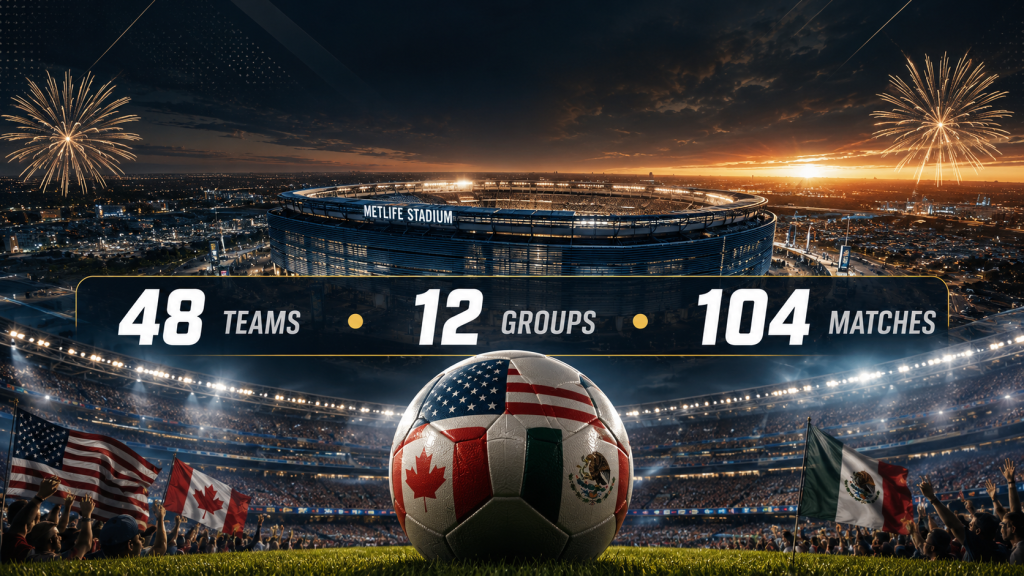

The World Cup 2026 format features 48 teams split into 12 groups of four. Each team plays three group matches. The top two from each group, plus the eight best third-placed teams, advance to a new Round of 32. The tournament runs from June 11 to July 19, 2026, across the United States, Canada, and Mexico.
Key Takeaways
48 teams compete — up from 32 at every World Cup since 1998
Teams are drawn into 12 groups (A–L) of four teams each
32 teams advance from the group stage: top two per group plus the eight best third-placed finishers
A brand-new Round of 32 replaces the old Round of 16 as the first knockout stage
104 total matches will be played — compared to 64 at the 2022 World Cup
The tournament is co-hosted by the United States, Canada, and Mexico — a first in history
The final takes place on July 19, 2026, at MetLife Stadium in New Jersey
Something genuinely unprecedented is happening this summer, and it goes beyond the football itself.
The 2026 FIFA World Cup is the biggest, most ambitious tournament the sport has ever staged. For the first time in history, 48 national teams will compete for the game’s ultimate prize, spread across three host nations and 16 cities over 39 days. The sheer scale of it — logistically, commercially, culturally — is almost difficult to wrap your head around.
Understanding the World Cup 2026 format is essential before the tournament kicks off on June 11. This is not the same competition you watched in Qatar or Brazil. The rules have changed, the bracket has changed, and a brand-new knockout round has been added that didn’t exist at any previous World Cup.
This guide walks you through every element of the new format — from the group stage draw to the final in New Jersey — and explains what each change means for teams, fans, and the tournament itself.
How Many Teams Are in World Cup 2026?
For the first time ever, 48 teams will take part in the FIFA World Cup.
Every previous tournament since 1998 featured 32 teams. Before that, the 1982–1994 editions had 24. FIFA’s decision to expand to 48, approved back in 2017, represents the most significant structural change to the World Cup in nearly 30 years.
So why did FIFA make the move?
The official rationale centres on inclusion. Expanding to 48 teams means more nations from Africa, Asia, CONCACAF, and Oceania earn a spot at the biggest stage in football. At the 2022 World Cup in Qatar, Africa had five spots. In 2026, that rises to nine. Asia goes from five to eight. CONCACAF — the region that includes the United States, Canada, and Mexico — jumps from three and a half spots to six.
In theory, that means more competitive football from a wider range of footballing cultures, and genuine first-time qualifiers mixing it with the world’s elite.
The counterargument is a familiar one: more teams means more matches, a longer tournament, and the risk of mismatches in the group stage. Critics have pointed out that expanding the field dilutes competition at the top, and that player welfare — already strained by club commitments — takes another hit from the extended schedule.
Both sides have merit. But FIFA’s decision is final, and the 48-team structure is here for 2026 and beyond.
How Do the 12 Groups Work?
The 48 teams are divided into 12 groups of four, labelled A through L.
Inside each group, every team plays the other three sides once. That means three matches per team in the group stage — the same guarantee that has existed at every World Cup since 1994. FIFA insisted on preserving the three-game minimum when expanding the format; it ensures every nation at least has a proper tournament to play before heading home.
The seeding process for the draw follows FIFA World Rankings. The top-ranked qualified nations go into Pot 1 (one per group), with teams distributed across Pots 2, 3, and 4 from there. That system is designed to prevent the strongest sides from clustering — you won’t find England, France, and Germany all trapped in the same group.
There are also confederation restrictions: no group can contain more than two UEFA (European) teams, ensuring competitive variety throughout the bracket.
The points system is unchanged. A win earns three points, a draw earns one, a defeat earns none. Standard stuff.
Where it gets more complicated is tiebreaking. If two or more teams finish level on points, FIFA apply the following criteria in this exact order:
- Goal difference across all group matches
- Goals scored across all group matches
- Head-to-head points between the tied teams
- Head-to-head goal difference between the tied teams
- Head-to-head goals scored between the tied teams
- Fair play ranking (yellow and red cards)
- Drawing of lots
It’s the drawing-of-lots element that always sends journalists scrambling for clarification before a tournament. Thankfully, it rarely gets that far.
How Do Teams Qualify from the Group Stage?
Here’s where the new format introduces one of its most distinctive features.
At the 2022 World Cup in Qatar, 32 teams competed in eight groups. The top two from each group advanced — 16 teams total — and the tournament immediately moved to the Round of 16 knockout stage.
In 2026, the maths work differently.
Stage Teams Advanced
Group winners (12 groups) 12 teams
Group runners-up (12 groups) 12 teams
Best third-placed teams 8 teams
Total advancing 32 teams
The eight best third-placed teams is the key new rule. Across 12 groups, there will be 12 teams finishing third. Of those 12, eight advance — selected based on points earned, then goal difference, then goals scored if still tied.
This rule matters because it fundamentally changes how teams approach their third match. At previous World Cups, a side already eliminated after two games had little to play for. Now, a team sitting third with three points (one win, two defeats) could absolutely still advance. That keeps matches meaningful deeper into the group stage, and it should limit the problem of dead-rubber games where both sides have nothing at stake.
It also creates some inherent complexity. Fans won’t know exactly which third-placed teams advance until all 12 groups have been completed — and the bracket matchups can shift based on where the qualifying third-placed teams finish. It’s a trade-off FIFA clearly judged was worth making.
What Is the New Round of 32?
The Round of 32 is entirely new. It has never existed at a men’s FIFA World Cup before.
At every tournament since 1998, the first knockout round was the Round of 16 — 16 teams, eight matches, eight survivors. With 32 teams advancing in 2026, a full extra knockout round is needed before the traditional bracket can take shape.
So the format now runs: Round of 32 → Round of 16 → Quarter-finals → Semi-finals → Final.
There are 32 matches in the knockout phase in total (16 in the Round of 32, eight in the Round of 16, four quarter-finals, two semi-finals, the third-place match, and the final).
The bracket structure has been designed so group winners and runners-up from the same group can only meet in the final, preventing instant rematches in the knockout stage.
As in all previous World Cups, knockout matches level after 90 minutes go to 30 minutes of extra time. If still level after that, it goes to a penalty shootout. That drama remains completely unchanged.
FIFA added the Round of 32 because the arithmetic demanded it. With 32 teams advancing from the group stage, you simply need an extra round to get back to the familiar quarter-finals and beyond. Whether it adds to or dilutes the drama of the knockout stage will be one of the tournament’s most interesting questions to answer in real time.
World Cup 2026 Host Countries & Venues
For the first time in football history, the FIFA World Cup is being hosted by three nations simultaneously.
The United States, Canada, and Mexico were awarded the 2026 tournament as a joint bid — a decision that makes sense geographically and commercially, even if it creates unprecedented logistical challenges. Teams and fans will be travelling across time zones, navigating different visa requirements, and adjusting to three entirely different footballing cultures.
The United States hosts the largest share of matches, with 11 of the 16 venues and the majority of knockout-round fixtures. Iconic NFL stadiums have been adapted for football (soccer), with temporary pitches replacing American football turf and branding revised for the tournament.
Mexico hosts three venues, including Estadio Azteca in Mexico City — one of the most famous football grounds on earth. Azteca is already the only stadium to have hosted two World Cup finals (1970 and 1986), and in 2026 it will make history again by hosting the tournament’s opening match, becoming the first venue ever to host games at three separate men’s World Cups.
Canada hosts two venues, including BMO Field in Toronto, which received a $146 million renovation specifically for the tournament. Canada’s appearance as a co-host marks the first time the country has staged men’s World Cup football since it shared hosting duties with the US and Mexico back in 1994.
Here are some of the key venues across all three countries:
United States:
- MetLife Stadium, East Rutherford, New Jersey (World Cup Final)
- AT&T Stadium, Arlington, Texas (Semifinal) — the largest venue at 94,000 seats
- Mercedes-Benz Stadium, Atlanta (Semifinal)
- Hard Rock Stadium, Miami (Third-place match)
- SoFi Stadium, Inglewood, California
- Arrowhead Stadium, Kansas City
- Lincoln Financial Field, Philadelphia
- Gillette Stadium, Foxborough, Massachusetts
- Lumen Field, Seattle
Mexico:
- Estadio Azteca, Mexico City (Opening match)
- Estadio BBVA, Monterrey
- Estadio Akron, Guadalajara
Canada:
- BMO Field, Toronto
- BC Place, Vancouver
The final will be held at MetLife Stadium in East Rutherford, New Jersey — home of the NFL’s New York Giants and New York Jets, with a capacity of more than 82,000. In FIFA’s tournament branding, it is listed as New York/New Jersey Stadium.
World Cup 2026 Schedule
The tournament runs for 39 days, from June 11 to July 19, 2026.
Opening Match: June 11, 2026 — Mexico vs. South Africa at Estadio Azteca, Mexico City
Final: July 19, 2026 — MetLife Stadium, New Jersey
Here’s the broad phase-by-phase breakdown:
Group Stage: June 11 – June 27
72 matches across 12 groups. Each team plays three games. By the end of the group stage, 32 teams will have been confirmed for the knockout rounds.
Round of 32: June 29 – July 3
The first-ever Round of 32 at a World Cup. 16 matches, with group winners facing qualifying third-placed teams and runners-up facing other runners-up or third-place finishers depending on the bracket.
Round of 16: July 5 – July 8
Eight matches. The traditional knockout drama begins here for many fans.
Quarter-Finals: July 10 – July 11
Four matches to determine the final four.
Semi-Finals: July 14 – July 15
AT&T Stadium in Dallas hosts one semi-final; Mercedes-Benz Stadium in Atlanta hosts the other.
Third-Place Match: July 18
Hard Rock Stadium in Miami.
Final: July 19
MetLife Stadium, New Jersey.
The US men’s national team opens its campaign on June 12 at SoFi Stadium against Paraguay, before subsequent group stage fixtures in Seattle. Canada begins on June 12 against Bosnia and Herzegovina in Toronto.
How Many Matches Will Be Played in World Cup 2026?
The answer is 104 — and that number tells you everything about the scale of this tournament.
At Qatar 2022, 64 matches were played over 29 days. France 2018 was also 64 matches. The jump to 104 represents a 62.5% increase in total match volume.
- The breakdown is as follows:
- Group stage: 72 matches (six per group across 12 groups)
- Round of 32: 16 matches
- Round of 16: 8 matches
- Quarter-finals: 4 matches
- Semi-finals: 2 matches
- Third-place match: 1 match
- Final: 1 match
- Total: 104 matches
For broadcasters and sponsors, those extra 40 matches represent enormous commercial value. For players, they represent increased physical demand at the end of an already punishing club season.
The player welfare concern is genuine and worth taking seriously. Several leading managers and the global players’ union FIFPRO have raised flags about the cumulative impact of an expanding international calendar. FIFA argues the minimum three-game guarantee and structured rest periods between matches address this concern adequately. That debate will continue long after the final whistle in July.
Advantages and Challenges of the New Format
No format change at this scale is without trade-offs. Here’s an honest assessment of both sides.
Advantages
The most compelling argument for expansion is inclusion. Nations from underrepresented confederations now have a genuine route to the world’s biggest stage. Teams from the Pacific Islands, smaller African nations, and emerging Asian footballing cultures will appear at a World Cup they could not have qualified for under the old system. For global football development, that matters.
More teams also means more drama in the group stage. With 12 groups and the third-place route to qualification, virtually every match carries weight right to the final minutes. The dead-rubber problem — meaningless final group games where two already-eliminated sides go through the motions — is significantly reduced.
Commercially, 104 matches is a powerful product. More broadcast slots, more sponsorship opportunities, and a longer tournament window across three nations with vast populations of football fans.
Challenges
The most legitimate concern is match quality. A 48-team tournament inevitably includes some significant gaps in quality between the world’s elite nations and newly qualified sides. Group-stage mismatches — blowout results that fail to test top teams — are a reasonable worry.
Travel and logistics represent an unprecedented challenge. Players, staff, and fans will cross time zones, navigate three different national visa systems, and cover enormous distances between matches. The United States alone spans four time zones.
Player welfare remains a simmering issue. The World Cup expansion sits alongside FIFA’s expanded Club World Cup in the same summer, creating questions about fixture congestion that the football world hasn’t fully resolved.
And there’s the pure question of bracket complexity. For the casual fan, understanding exactly which third-placed teams advance and how the Round of 32 bracket is seeded requires more homework than any previous World Cup.
Frequently Asked Questions
How does World Cup 2026 work?
48 teams compete in 12 groups of four. Each team plays three matches. The top two teams from each group advance automatically to the knockout stage, joined by the eight best third-placed finishers from across all 12 groups. That gives 32 teams in the knockout phase, which begins with a new Round of 32, then runs through the Round of 16, quarter-finals, semi-finals, and the final.
How many teams are in World Cup 2026?
48 teams — the most ever at a FIFA World Cup, up from 32 at every previous tournament since 1998.
How many matches will be played at World Cup 2026?
104 matches in total: 72 in the group stage and 32 in the knockout rounds.
What is the new World Cup format?
The new format adds 16 extra teams (up from 32 to 48), splits them into 12 groups of four instead of eight groups of four, and introduces a completely new Round of 32 as the first knockout stage. The best eight third-placed teams from the group stage also advance — a rule that didn’t exist at previous World Cups.
Why did FIFA expand the World Cup?
FIFA expanded to 48 teams primarily to increase global representation and inclusion, giving more slots to confederations in Africa, Asia, CONCACAF, and Oceania. The expansion also significantly increases the tournament’s commercial value through additional matches and a broader geographic footprint.
Which country hosts the World Cup 2026 final?
The final is hosted by the United States, at MetLife Stadium in East Rutherford, New Jersey, on July 19, 2026.
Conclusion
The World Cup 2026 format is not a minor adjustment — it’s a fundamental reimagining of the tournament.
Forty-eight teams. Twelve groups. A brand-new Round of 32. Three host nations. One hundred and four matches. These are numbers without precedent in FIFA World Cup history, and they reflect an organisation determined to make this the most ambitious tournament ever staged.
Whether the new format enhances the competition or dilutes it is a question only the matches themselves can answer. The structural changes create real opportunities — for smaller nations to make their mark, for fans in underserved regions to see their teams at the World Cup, and for neutral observers to witness high-stakes football from a far wider range of footballing cultures.
The logistical scale is genuinely staggering. But so, frankly, is the potential.
From the opening whistle at Estadio Azteca on June 11 to the final at MetLife Stadium on July 19, the World Cup 2026 format will be tested, scrutinised, and debated in real time. One thing is already certain: this will be unlike any World Cup that has come before it.
For Newsletter or Email us: hello@sportsexpress.site


